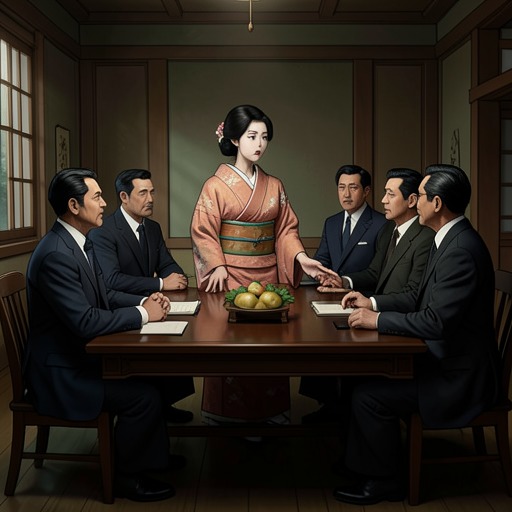
Sayuri enters a danna arrangement with General Tottori
Memoirs of a GeishaSayuri enters a danna arrangement with General Tottori at eighteen, in an alliance that Mameha helps secure by turning the General’s new military-procurement position into a promise of practical support for the Nitta okiya. The arrangement is a sharp distinction between private comfort and institutional value: it does little to transform Sayuri’s daily life, yet supplies the household with money, medicine, tea, sugar, and chocolates as the war’s shortages intensify. It also separates her from Nobu and, through his withdrawal, narrows her chances of seeing the Chairman.
Background and Negotiation
The arrangement takes shape when Mother is deciding Sayuri’s future as a patron’s mistress. Mameha asks whether the most generous offer has come from Nobu Toshikazu, and Mother replies that his is the only offer. Mameha points out that a contest among several men would produce more favorable terms, then introduces General Tottori as a possible alternative. Her intervention is not simply matchmaking: she is trying to rescue Sayuri from a match with Nobu, though Sayuri cannot tell whether Mameha’s motive is gratitude or some other purpose.
Mameha presents the General’s recent appointment to military procurement as a source of leverage. The position, she explains, gives him influence over supplies and makes him newly able to take a mistress. Mother initially doubts that a military man can provide the steady income she wants, and dismisses the prospect of wartime shortages. Mameha counters that the General can help the okiya whether or not the war continues, describing his reach over resources entering Japan through its ports. The claim overstates his formal authority: he oversees one of five large administrative areas, although his seniority over the other district officials gives Mameha’s description practical force. Mother responds by investigating him, spending the next week making calls around Gion and gathering information.
The Ceremony and Its Immediate Meaning
During September, while Sayuri is still eighteen, she and the General drink sake together in a ceremony at the Ichiriki Teahouse. The ritual recalls two earlier milestones: the ceremony Sayuri performed with Mameha when Mameha became her older sister, and the one with Dr. Crab just before Sayuri’s mizuage. Now the same formal gesture marks an alliance with a danna. In the weeks afterward, people congratulate Mother on having made a favorable arrangement, underscoring how the ceremony’s consequences extend beyond Sayuri to the okiya’s finances and prospects.
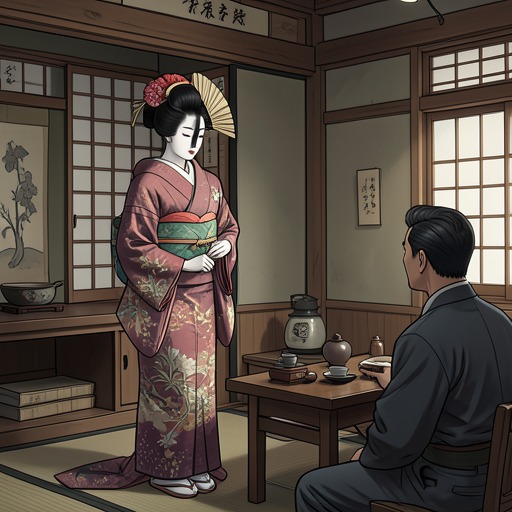
That first night, the General directs Sayuri to a small inn in northwest Kyoto called Suruya. It has only three rooms, and its shabby, damp surroundings surprise her after the lavish settings to which she has grown accustomed. The contrast unsettles her enough that she feels relieved when the General arrives, but he merely turns on the radio and drinks beer. The meeting offers little evidence of the indulgent patronage she might have expected from a danna; from its outset, the arrangement is defined less by personal luxury than by practical alliance.
What the Arrangement Provides
Sayuri’s working life changes very little. She continues making her nightly rounds of Gion, while the anticipated signs of a wealthy patron’s care never materialize: no prominent dance recitals financed by him, lavish presents, or paid days of leisure. She sometimes accompanies men on unusual afternoon outings, including a visit to a man’s brother in hospital, but these excursions do not amount to the transformation she had imagined. Mother’s warning proves accurate in one respect: the General does not care for a geisha as a businessman or aristocrat might.
His value, however, is substantial from Mother’s point of view. He pays many ordinary expenses associated with Sayuri, including her lessons, annual registration fee, and medical costs. The support reaches beyond her personal bills: when Auntie becomes ill in March 1939 and ordinary doctors cannot help, a call to the General brings an important doctor from the military hospital in Kamigyo Ward, whose medicine cures her.
The General also sends regular supplies of tea and sugar and provides chocolates, goods growing scarce even in Gion. These deliveries make the difference between an unimpressive private patron and a powerful ally for the household. Mameha had argued that military influence could matter regardless of the war’s duration; the worsening shortages bear out the practical force of that argument. Mother had predicted that the war would end within six months, but the okiya had scarcely entered the dark years ahead.
Estrangement and Consequences
The alliance changes Sayuri’s relationships even where it fails to change her routine. She continues seeing Nobu while the negotiations drag on, trying to behave as though nothing has shifted. She had expected to become his mistress by mid-July, but the negotiations go nowhere. Once the General becomes her danna in the fall, Nobu stops inviting her to the parties where she had often entertained him and eventually stops coming to the Ichiriki altogether. Sayuri suspects that he is avoiding her; when she sends him a New Year’s card, as she does to her other patrons, he does not answer.
His absence leaves Sayuri distressed because she believes she has wronged a man who treated her kindly and whom she had come to regard as a friend. It also has a concrete professional consequence: without Nobu’s patronage, she is no longer invited to Iwamura Electric’s parties, so she has little chance of seeing the Chairman. The General’s arrangement therefore protects and benefits the okiya materially while narrowing Sayuri’s access to the business circle that connected her to the Chairman. Its significance lies in that uneven exchange: institutional security improves, but the emotional and social world Sayuri hoped to preserve contracts.
Narrative Significance
The episode sets public success against private disappointment. Mother’s judgment of the arrangement is vindicated by the General’s payments, supplies, and intervention when Auntie falls ill; Sayuri’s anticipated rewards, by contrast, never arrive. The mismatch does not make the alliance useless. It reveals that patronage operates through more than conspicuous gifts: influence over scarce necessities can matter more to the household than spectacle or leisure.
The episode also makes the price of that practical support legible through the silence left by Nobu. Sayuri’s new patron is valuable to the okiya precisely in the material conditions of wartime scarcity, yet her bond with Nobu’s circle weakens, reducing her opportunity to encounter the Chairman. The arrangement thus advances the household’s survival without securing Sayuri’s emotional wishes. Its outcome is neither a simple romantic choice nor a simple financial victory, but a bargain whose benefits fall unevenly across the people bound up in it.